 SKN
SKN GRN
GRN LCA
LCA BER
BER JAM
JAM HON
HON GUA
GUA SLV
SLV QAT_U19
 AZE
AZE PRK
PRK CHN
CHN ARM
ARM MNE
MNE GEO
GEO UKR
UKR LVA
LVA CYP
CYP TUR
TUR ITA
ITA SWE
SWE POL
POL ROU
ROU BIH
BIH NIR
NIR HUN
HUN BEL
BEL FRA
FRA JPN
JPN VEN
VEN KOR
KOR URU
URU GLP
GLP BRB
BRB CUB
CUB SUR
SUR MTQ
MTQ ZIM
ZIM COD
COD CTA
CTA BFA
BFA EQG
EQG SLE
SLE TUN
TUN BOT
BOT SSL
SSL LIB
LIB OLI
OLI KHA
KHA WAK
WAK SHA
SHA DUH
DUH SAI
SAI RAY
RAY DEN
DEN ENG
ENG WAN
WAN ALB
ALBÁngel Labruna: the fan who became a River Plate legend as player and coach
The all-time leading scorer in the Superclásico and a champion both as a player and a manager, his birthday now stands as River Plate's official Fan Day.

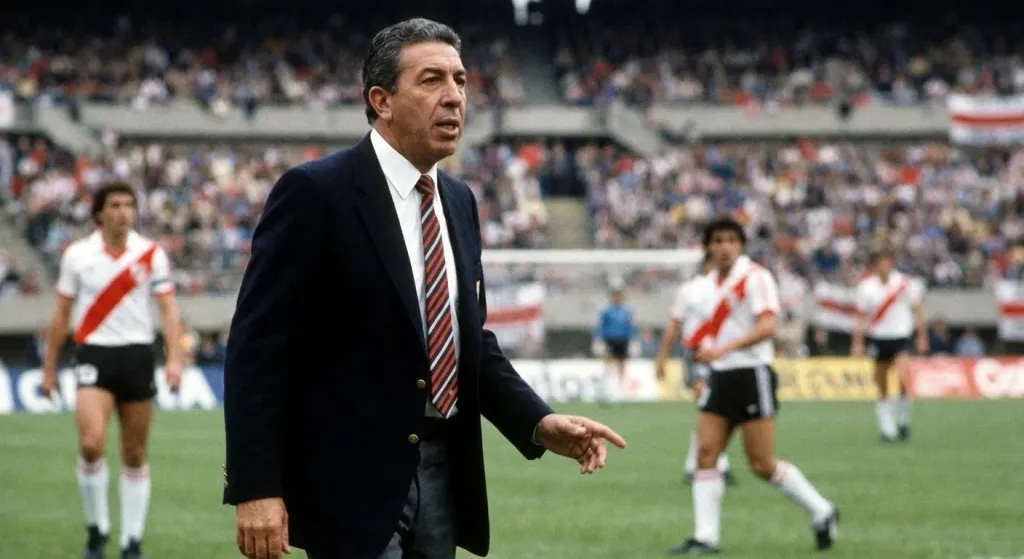
Some players win titles. Others become part of the badge itself. Ángel Amadeo Labruna belongs to that second group, so woven into River Plate's history that even the calendar ended up paying him tribute: he was born on September 28, 1918, and that date is now celebrated as River's Fan Day.
He grew up just a few blocks from the club's old stadium, became a member while still a boy, and never let go of that jersey, not even after he stopped playing. His father, a watchmaker by trade, wanted him to learn the family business. Labruna had other plans. "The sandlot pulled at me, and I became a soccer player," he said years later, with that mix of mischief and pride that stayed with him his whole life. His mother, in on the rebellion, would lay out his clothes so he could sneak off to play.
His first-team debut came on June 18, 1939, against Estudiantes de La Plata, a loss that sent him back down to the reserves. But a players' strike gave him a second chance, and this time he made the most of it: playing for the squad nicknamed "Los Guerrilleros," he scored seven goals in nine matches and earned a spot he would never give up.
La Máquina and a Superclásico built for him
On September 21, 1941, River thrashed Independiente 4-0, fielding for the first time the full forward line that would live on in Argentine soccer memory: Muñoz, Moreno, Pedernera, Labruna, and Loustau. This was La Máquina, all constant motion and swapped positions, and Labruna always seemed to find the right spot near goal.
Against Boca, that instinct became legend: 16 goals in 36 official clásicos made him the all-time leading scorer in the Superclásico, a record that still stands today. His first goal against the eternal rival came on November 5, 1939, in a 2-1 win. Oscar Más used to recall a line Labruna repeated to his teammates:
"For me, the greatest joy there is is beating Boca and celebrating the goals right there in the Bombonera"Ángel Labruna
By the time he hung up his boots, he had racked up 546 matches and 317 goals in River's colors, along with nine titles as a player across nearly 21 seasons tied to the first team.
Behind the idol was a man of contrasts: hot-tempered and fiercely competitive on the field, superstitious down to the smallest detail (he avoided stepping on the lines with his left foot), and an unapologetic horse racing fan. "I've been going to the races for almost forty years now. Invite me to the movies or the theater, I'll pass. But the races, I love them," he once said. At home, though, his son Omar remembered him as someone "super simple" and very much a family man.
The comeback that ended an 18-year wait
River had gone nearly two decades without a title when Labruna returned as head coach in 1975. He didn't leave room for doubt: "If I take charge of River, it's to be champion," he warned before taking the job. On August 14, 1975, he made good on that promise by winning the Metropolitano Championship and was carried off on his players' shoulders, one of the most cherished images in the club's history. As River's manager, he won six titles in all between 1975 and 1980.
With the national team, he played 37 matches, scored 17 goals, and was crowned South American champion in 1946 and 1955, on top of playing at the 1958 World Cup in Sweden at age 39. He died on September 19, 1983, at 64 years old, and the Monumental gave him its farewell.
Today, every September 28, River remembers him for exactly what he was: a fan who became a legend without ever stopping being a fan. As he himself used to say: "If I had to choose between River and my life, I'd choose River, because River is my life."