 NE
 MIA
 CSL
 NCX
 VAR
 MOR
 FCU
 CAR
 CLT
 NAP
 CRB
 MET
 DLG
 POR
 LAN
 GMD
 LAF
 MIN
 POR
 HOU
 CAZ
 LEO
 ISF
 ONC
 ATL
 ALI
 AGU
 FAS
 ANT
 MUN
 GUA
 COB
 COM
 MIX
 MOT
 MAR
 OLA
 WAH
 HAT
 JAZ
 BAN
 SHJ
 NAS
 PZH
 MTK
 NM
 PHX
 SAC
 TUL
 PRO
 DEF
 BOS
 CIT
 DAN
 NAC
 LIV
 JUV
 KNX
 LIV
 ARS
 GET
 SEV
 RAC
 RMA
 ELC
 VAL
 ATH
 RSO
 VAN
 SEA
 ATL
 TOR
Arsenal and Coventry to test new Premier League rules born from the 2026 World Cup
The Premier League adopts several changes from the international tournament but rejects others, including mandatory hydration breaks.

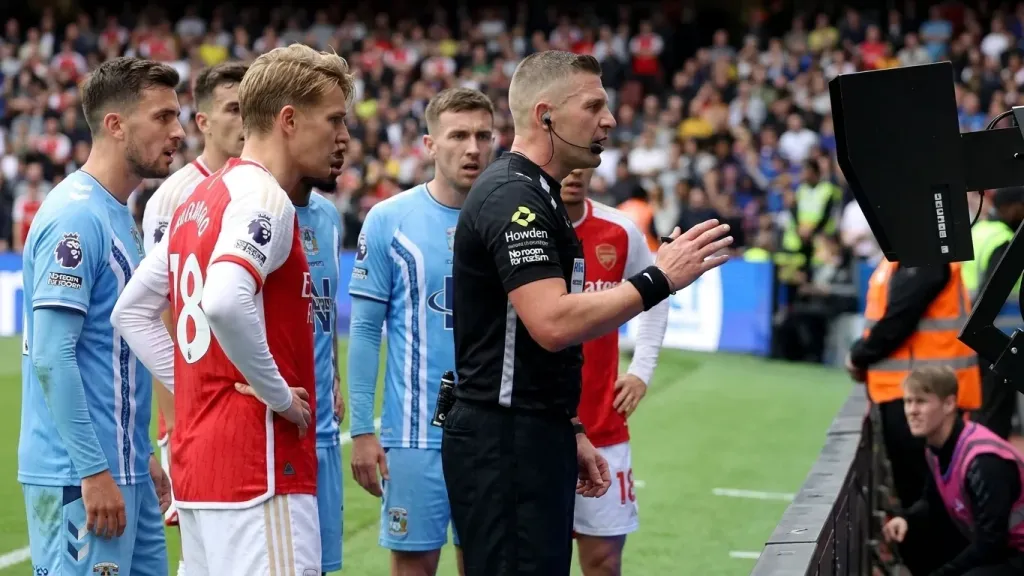
Arsenal hosts Coventry City in the opening match of the 2026-27 season, and beyond the result itself, something is bound to catch the eye of anyone who followed the 2026 World Cup: several rules trialed at the tournament are now arriving in the Premier League. Others, meanwhile, are staying behind as World Cup memories. It's worth going through what actually changes on English soil and what doesn't.
More time off the field for injuries
The change likely to generate the most noise involves on-field medical treatment. Until now, a player being treated on the pitch had to leave it for 30 seconds. That rule, according to last season's data, worked: there was a 70% reduction in on-field medical stoppages, one of the most common tactics used to break up a match's rhythm. Now that window doubles to one minute, a change that comes directly from IFAB, the body that governs the laws of the game, leaving the Premier League no room to reject it. Playing sixty seconds down a man could weigh heavily, and then some, at a tense moment in a match.
Countdown clocks for throw-ins and goal kicks
Also arriving from the World Cup is the five-second countdown for taking throw-ins and goal kicks. If the referee judges that a player is stalling without justification, the count begins, and if time runs out, the throw or kick is awarded to the opposing team. Interestingly, the clock doesn't start the moment the ball reaches the taker's hands, but rather when the official perceives deliberate delay, so referee judgment still plays a role. It was a well-received measure at the World Cup, and the expectation is that it will have a similar effect in England.
Something similar applies to substitutions: players will have ten seconds to leave the field once they've been subbed off. If they exceed that window, the incoming substitute will have to wait until the next stoppage in play or until a minute has passed, whichever comes first. It's a penalty designed to put an end to those endless, almost calculated exits that frustrate opponents, coaches and fans alike. Some referee flexibility is expected, though: if a player is already walking toward the touchline, it's unlikely he'll be penalized for running a few seconds over.
VAR gains two new tools
Video review is also getting an update. From now on, a second yellow card can be reviewed when there's an objective error, for example if a player is booked for a tackle that never actually happened. It won't be used to review subjective calls or matters of referee interpretation, only clear-cut facts, but it provides a path to correct a sending-off that amounts, in practice, to a straight red.
The other new addition is review for mistaken identity: if the referee cautions the wrong player, VAR will be able to correct it. That said, the Premier League will apply the rule more strictly than it was used at the World Cup: the card can only be reassigned within the same offense. It won't be possible, as it was at the World Cup, to rescind a yellow given for a foul and then book the attacker for simulation instead, since that would count as a separate offense.
What's being left out
Not everything seen at the World Cup is crossing the Atlantic. VAR won't step in when a corner kick is awarded incorrectly, something that in practice happens very rarely and that the Premier League prefers not to institutionalize for now, though a high-profile controversy could reopen the debate down the road.
Also not being adopted is the rule that shielded players from being sent off for covering their mouths during on-field arguments, a well-intentioned measure but one of questionable real-world effectiveness, according to those who studied it closely. And mandatory hydration breaks, that World Cup moment that even doubled as a window for TV advertising, won't become a fixed rule either: they can still happen if the heat demands it, as already occurred in the first round of the Carabao Cup, but not as an automatic feature of every match.
On the overall package of changes, analysis from Andy, a regular commentator on English officiating, sums up the general feeling well:
A minute is a long time in football, and playing a man down for that stretch could influence a key moment of the match.Andy
The Premier League is starting the season with a hybrid rulebook: borrowing from the World Cup whatever it deems useful for speeding up the game, while discarding what it sees as unnecessary or untested. Arsenal-Coventry will serve, among other things, as the first real testing ground for these rules in domestic competition.