 ATH
 RSO
 VAN
 SEA
 MAR
 TOU
 SMT
 COL
 SUP
 CAV
 GRE
 ATL
 GUA
 BOL
 CCP
 OLI
 CAG
 UNI
 LEX
 COS
 GUA
 LIB
 BEL
 BAC
 NOB
 UNI
 BRA
 FAM
 JUV
 NAP
 DAN
 NAC
 ATL
 TOR
 NSH
 RBNY
 NE
 MIA
 LAF
 MIN
 POR
 HOU
 CSL
 NCX
 CAZ
 LEO
 GTI
 QAC
 VAR
 MOR
 ISF
 ONC
 ATL
 ALI
 AGU
 FAS
 ANT
 MUN
 GUA
 COB
 COM
 MIX
 MOT
 MAR
 OLA
 FCU
 CAR
 LA
 BOS
 BAY
 SD
 GFC
 UTA
 HOU
 POR
El Clásico: More Than a Century of Barcelona vs. Real Madrid, Done Big
From the 3-1 scoreline of 1902 to the Messi-Cristiano era, here's how El Clásico became the most-watched match in the world.

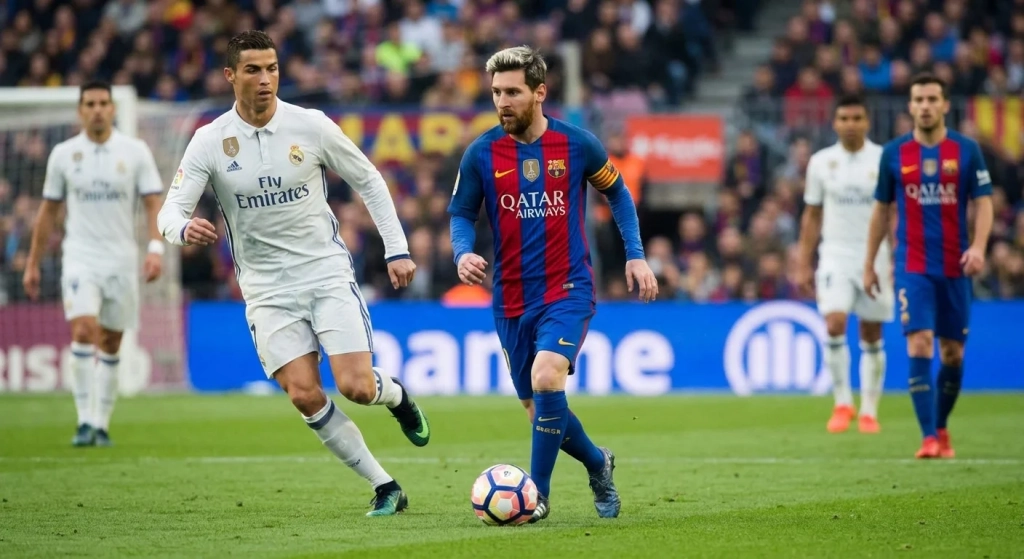
Some matches are decided in ninety minutes. Others have been playing out for more than a century. El Clásico belongs to that second category: no other club fixture draws such a global audience or carries so much symbolic weight. It's not just the most-watched match in soccer, it's the collision of two ways of understanding a country, a sport and even life itself. And it all started long before most people realize.
An origin that goes beyond soccer
The first official meeting dates back to May 13, 1902, during the Coronation Cup, a tournament organized to celebrate Alfonso XIII coming of age. That day, a cosmopolitan Barcelona side, shaped heavily by foreign founders, thrashed a still-forming Real Madrid 3-1. It sounds like a footnote, but it isn't: that's where the seed was planted for something that would outgrow the sport itself.
Over the years, that tension hardened into pure identity. Barcelona embraced "Més que un club" ("More than a club") and became a refuge for Catalan sentiment during periods of political repression. On the other side, Real Madrid came to carry the weight of representing national stability, especially after the king granted the club the title of "Real" in 1920. It didn't even take continental trophies to set the tone: by the 1920s, with the opening of Les Corts in 1922 and Chamartín in 1924, each club was already making clear it wanted to control the narrative of Spanish soccer.
Two clubs, nearly every title
Can you picture a league where the champion comes from the same two places two out of every three seasons? That's Spain. Since La Liga was founded in 1929, Barcelona and Real Madrid have combined for 63 of the 95 titles awarded through 2026. Only in a handful of stretches, like Atlético in the 1940s, the Basque clubs in the 1980s or Valencia in the early 2000s, has anyone managed to crash a party usually reserved for just two guests.
Di Stéfano, the signing that changed everything
Modern Clásico history pivots on one date: 1953, when Alfredo Di Stéfano, after a legal dispute between the two clubs, ended up in white. In Barcelona, that was felt as a historic wound. With "La Saeta Rubia" as its engine, Real Madrid became the undisputed ruler of the fledgling European Cup, winning the first five editions in a row between 1956 and 1960. Barcelona, meanwhile, fought back with Kubala and the construction of Camp Nou in 1957, but was left in the shadow of that international explosion in white.
Cruyff flips the script
Johan Cruyff's arrival as a player in 1973 ended a 14-year title drought for Barcelona and produced an image still remembered today: the 5-0 at the Santiago Bernabéu. But the heaviest blow came with Cruyff as coach: between 1990 and 1994, his "Dream Team" won four straight league titles, two of them snatched away from Real Madrid on the final matchday in Tenerife. And on May 20, 1992, with a goal from Ronald Koeman at Wembley, Barcelona lifted its first European Cup, shedding a complex it had carried since the Di Stéfano years.
Messi, Cristiano and the most-watched match on the planet
Between 2009 and 2018, El Clásico became something else entirely. With Lionel Messi and Cristiano Ronaldo sharing the era, every match doubled as a personal final for the Ballon d'Or. These were games watched by more than 600 million viewers in over 180 countries, and both Barcelona and Real Madrid became the two most valuable franchises in global sports. Messi's creativity against Cristiano's power and goal-scoring hunger: few individual rivalries have ever been lived with that kind of intensity.
Add it all up and the overall record is almost dead even on paper, but it reflects real balance: 265 matches played, with 107 wins for Real Madrid, 106 for Barcelona and 52 draws. In goals, Madrid leads 446 to Barcelona's 440. In league play alone they've met 192 times, with 81 wins for Madrid, 76 for Barcelona and 35 draws. Numbers that, more than a century after that 3-1 in 1902, are still being written match by match.