 EUP
 EXC
 CHA
 LAL
 ATO
 FOR
 CBR
 EVE
 PAL
 VAS
 MPT
 HBS
 PAL
 VIC
 THS
 GUV
 UDG
 TEP
 CUS
 SBA
 SEV
 RMA
 LEX
 COS
 IVA
 LDU
 BOC
 RIV
 VIS
 RIO
 MAR
 SCL
 ATH
 RSO
 VAN
 SEA
 ATL
 TOR
 NSH
 RBNY
 NE
 MIA
 LAF
 MIN
 POR
 HOU
 CSL
 NCX
 CAZ
 LEO
 JUV
 NAP
 MAR
 TOU
 EBS
 LAC
 SKE
 VLL
 RFA
 FSC
 SMT
 COL
 GTI
 QAC
 VAR
 MOR
 SUP
 CAV
 ISF
 ONC
 GRE
 ATL
 ALI
 AGU
 FAS
 ANT
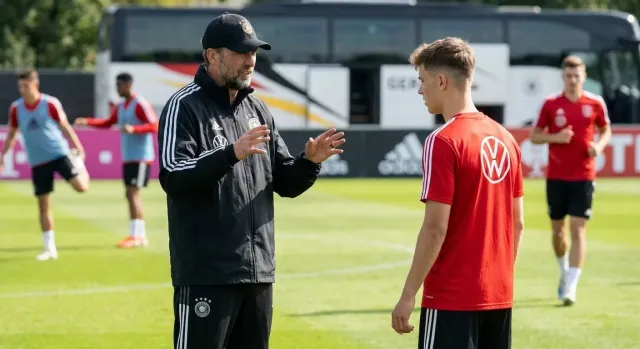
Klopp's Germany debut: intense pressing, but still searching for goals
With 44 call-ups and 16 debutants, the new coach tested a team that presses high but still struggles against opponents who sit deep.

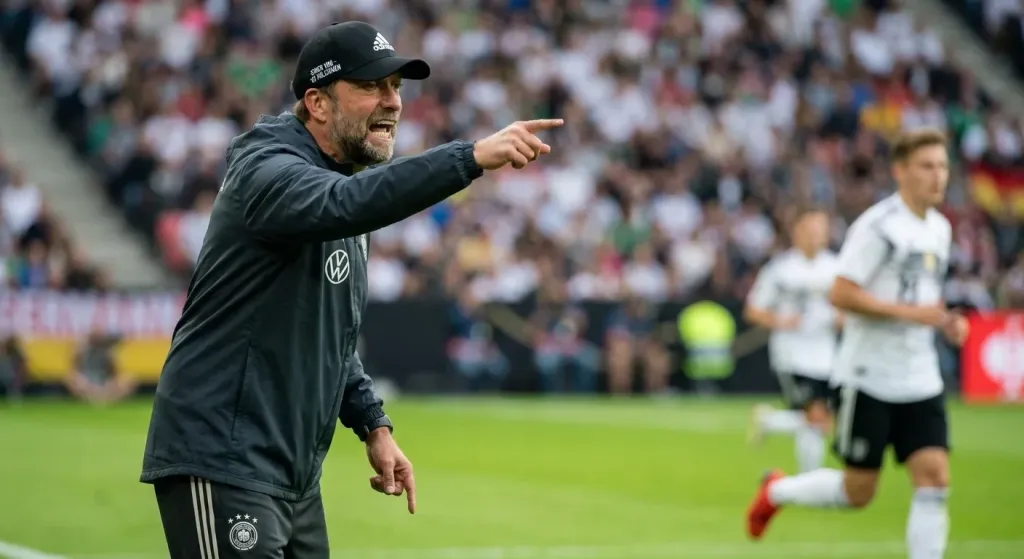
Four matches, 44 players called up and 16 debutants. That was the laboratory Jürgen Klopp set up in his first window in charge of Germany in the 2026/2027 Nations League. And as experiments tend to go, one thing was clear from the start: what happened on the field mattered more than what showed up on the scoreboard.
The numbers themselves aren't exactly thrilling. Germany won one of the four games, drew two and lost one, finishing third in Group A2 with five points, behind the Netherlands and Greece. The run went like this: a 1-1 draw against the Netherlands in Amsterdam, a 1-0 loss to Greece in Augsburg, a solid 2-0 win over Serbia in Munich, and a scoreless 0-0 finish against the Greeks in Thessaloniki.
Why call up so many players right out of the gate? Because Klopp needed to see firsthand what he had to work with before trying to build something more solid. And what started to emerge already carries his fingerprints: a Germany side that presses higher up the field, wins the ball back quickly, and hunts aggressively the moment possession is lost. The night in Munich against Serbia was the clearest snapshot of that idea, a young, dynamic team that held an extremely high tempo for long stretches of the match.
This performance has to be our baselineJürgen Klopp
The trouble starts when the opponent sits back. Greece proved it twice: first winning 1-0, then holding on for a 0-0 draw even as Germany created chances. Klopp didn't hide the shortfall: "We're not yet where we'd like to be."
Counter-pressing as the signature
The flashiest part of the new project shows up without the ball. Klopp wants players ready to pounce on opponents the instant possession is lost, winning it back close to where it slipped away. Against Serbia that mechanism clicked perfectly, leaving the coach thrilled: "Without the ball it was extraordinary, and with it we played wonderful football." He went further: "We can take every risk in the world when our counter-press is firing on all cylinders. And it was firing on all cylinders. It was extraordinarily good."
That same mechanism showed up in Thessaloniki too, even in a scoreless draw: Klopp reckoned the defensive counterattack worked "extraordinarily well 90 percent of the time." A foundation that's starting to take hold, though there are still gaps an opponent can exploit.
Wirtz, Bischof and Pavlovic, a partnership full of promise
Klopp split the window into two blocks with different lineups to get a broader read on the squad. The most promising combination showed up against Serbia: Tom Bischof opened the scoring in the 39th minute, Florian Wirtz made it 2-0 in the 61st, and Aleksandar Pavlovic rounded out a midfield that left a strong impression. "Wirtz was very happy to be playing and worked incredibly hard. It was extraordinary," the coach said, also making clear he doesn't need a fixed script for his star man: "We can play in different ways with different combinations. Our football has to stay consistent. The lineup can't, because there will always be injured players."
The window also gave new names a chance to emerge, including Derry Scherhant, Jonas Urbig and Mika Baur, who became the 1,000th player to represent Germany. Klopp was generous with his praise for the latter: "He's a wonderful player. Very smart, technically incredible. We need a lot of players for our shared future."
But the testing phase is coming to an end. Klopp has already warned that November's squad will be much smaller: "Of course, we won't go with 44 players. The door is open for everyone."
Breaking down a low block, the big unfinished test
If there's one exam Germany still hasn't passed, it's dismantling an opponent that sits deep. The loss to Greece in Augsburg made that painfully clear, and Klopp was honest about it: "It's hard to attack against a low block. You need clear mechanisms for that. In such a short time, we couldn't work on them the way we needed to." He even admitted the defeat left him with "some conclusions I didn't want to have," though without sounding any alarms.
The rematch in Thessaloniki showed a more polished version, with 21 shots, only four of which were on target. Jonathan Burkardt did find the net, but VAR ruled it out for a handball by Bischof in the buildup. Klopp summed it up precisely: "The lads put in an incredible performance, first class in every respect, except for the fact that we didn't convert our chances into goals or find the better-placed teammate in the final third." He added a detail that didn't go unnoticed: "Around the 60th minute we got a bit nervous and our movements lost their clarity."
The process is there, the results aren't, not yet
With five points out of a possible 12 and two decisive matchdays still ahead, away to Serbia on November 13 and hosting the Netherlands three days later, qualification for the quarterfinals remains very much alive. Lothar Matthäus, a 1990 World Cup champion, pointed out that "many aspects of their play still aren't quite clicking" and that the points earned "aren't up to the same level," though he also praised the progress of the younger players.
Klopp, for his part, sees the process through a different lens, especially given where Germany is coming from: knocked out in the round of 16 at the World Cup by Paraguay, a third straight blow at that stage of the tournament. "I'm very satisfied because I know where we're coming from," he said after the draw with Greece. "I'm very, very, very impressed with the team." And he went further: "If anything, I'm pleasantly surprised rather than disappointed."
Throwing the doors open also changed the mood within the group. "Everyone showed what they could do, everyone earned their place," the coach said, leaving a line that could define the coming months: "The door is open for everyone. Wide open."
Now comes the hard part: trimming the squad down to around 23 or 24 players, sustaining the intensity shown against Serbia, solving the puzzle of low blocks, and above all, finishing more chances. Klopp already has the horizon in sight: "We have to become an uncomfortable opponent for everyone, I'm one hundred percent convinced of that." The identity of the new cycle has already begun to take shape. Now it needs to turn into results.