 NSH
 RBNY
 CSL
 NCX
 GTI
 QAC
 FCU
 CAR
 LA
 BOS
 BAY
 SD
 GFC
 UTA
 HOU
 POR
 NC
 DEN
 LOU
 KC
 SEA
 ORL
 WAS
 CHI
 CRB
 MET
 DLG
 POR
 ATL
 TOR
 GRE
 ATL
 BEL
 BAC
 NOB
 UNI
 NE
 MIA
 LAF
 MIN
 POR
 HOU
 CAZ
 LEO
 VAR
 MOR
 ISF
 ONC
 ATL
 ALI
 AGU
 FAS
 ANT
 MUN
 GUA
 COB
 COM
 MIX
 MOT
 MAR
 OLA
 WAH
 HAT
 JAZ
 BAN
 SHJ
 NAS
 PZH
 MTK
 NM
 PHX
 SAC
 TUL
The Premier League's Title Race Runs Top to Bottom, and That's What Sets It Apart
Arsenal, City, Liverpool, Chelsea, Aston Villa and other clubs with comparable resources make sure almost no match is a formality.

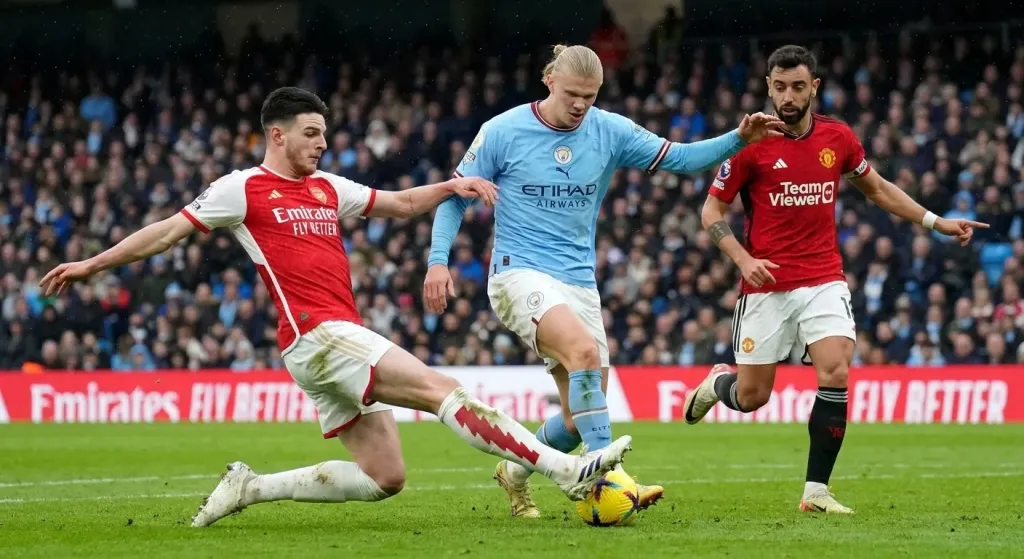
Arsenal waited 22 years to become champions of England again. When they finally got there last season, one thing became clear: in the Premier League, nothing is guaranteed, not even for the usual suspects. And that's maybe the best place to start understanding why so many people still call it the best league in the world.
It isn't Real Madrid's league, or Barcelona's, or Bayern Munich's, or Paris Saint-Germain's. It doesn't have every star on the planet packed into two or three teams. It has something else: competition spread from top to bottom. Arsenal, Manchester City, Liverpool, Manchester United, Chelsea, Aston Villa, Newcastle, Tottenham and Brighton make up such a wide band of clubs with the squads, infrastructure and money that almost no fixture on the calendar is a walkover. Some are fighting for the title, others are chasing a cup, others are rebuilding, but all of them cause problems for someone.
The quality isn't concentrated in four names
In Spain, it's a trio of Real Madrid, Barcelona and Atletico calling the shots. In Germany, everything revolves around Bayern. In France, PSG crushes any debate. England, by contrast, has a second and even a third tier of teams capable of taking down the giants. A mid-table club signs international stars, hires top-level coaches and keeps up a physical pace that forces the favorite to stay switched on for the full 90 minutes. Even newly promoted sides arrive with enough revenue to compete in the market with historic institutions from other countries. You see the result every weekend: one bad clearance or one set piece can ruin your afternoon against anybody.
Behind all of this is television money, which has turned the Premier League into a financial powerhouse with no real comparison. Mind you, spending doesn't guarantee titles: Manchester United and Chelsea proved that at different points, burning fortunes and building lopsided squads. But that economic muscle raises the floor for the entire league and explains why it now attracts not just established stars, but a good chunk of the young talent emerging in Spain, Germany, Italy, France, Portugal, the Netherlands and South America.
It's no longer just power and pace
For years, English football was associated with long balls and crosses into the box. That changed with the arrival of coaches and players from other schools of thought. The intensity is still there, but now it coexists with a more elaborate style of play: short passing, high pressing, verticality to reach the box quickly without relying on a target man. Attacking that way demands precision. Defending it demands even more.
That blend of tactical and physical demands explains why so many top players struggle to adjust when they first arrive in England. It isn't a question of technical level, it's that you have less time to think, the pressure is more intense and the opponent never lets up at any point in the match.
The Champions League doesn't always crown the best team either, but last season offered clear evidence of English depth. Arsenal won the Premier League and reached the Champions League final, where they fell on penalties to Paris Saint-Germain. Aston Villa took home the Europa League, and Crystal Palace, without being among the top English contenders, won the Conference League. Chelsea, meanwhile, remain the reigning Club World Cup champions.
The list of stars backs it up: Erling Haaland is still the most dominant scorer in the competition, Bukayo Saka and Declan Rice are the backbone of champion Arsenal, Florian Wirtz brings unpredictability to Liverpool, Cole Palmer has established himself at Chelsea and Bruno Guimaraes anchors one of the strongest midfields in the league. And the list keeps going: there are decisive names scattered across Manchester United, Newcastle, Aston Villa, Tottenham and Brighton. The talent doesn't live locked up in two or three clubs.
A new season is underway. Manchester City want their throne back, Liverpool have more than enough pedigree to be in the fight, and nobody knows yet who's going to surprise from below. That's the Premier League: it demands the same from you on matchday 3 as it does on matchday 35.