 CHE
 MUN
 LEV
 ATM
 RBS
 STU
 ANN
 MON
 GOK
 SAM
 CFC
 KER
 BJM
 IKS
 WPL
 PIA
 RUB
 FAK
 VAL
 EIB
 PIT
 BRO
 AIK
 DIF
 VIT
 NOR
 ÖFK
 BUR
 BAN
 FKA
 PEN
 BAN
 AFK
 IKS
 BUL
 ALT
 AKS
 RIZ
 PBT
 EVE
 MNU
 BOU
 LEE
 BRE
 NFO
 COV
 SUN
 HUL
 IPS
 MCI
 BHA
 TOT
 CRY
 AVL
 FUL
 RAY
 CEL
 BET
 MAL
 BAR
 ALA
 CLT
 ORL
 CLB
 DC
 CIN
 PHI
 NYC
 MTL
 SKC
 DAL
 STL
 SDG
 LAG
 ATX
 SJ
 RSL
Diego Maradona's Complete Career: From Argentinos Juniors to World Cup Glory in '86
From his debut at age 15 with Argentinos Juniors to glory in Naples and the 1986 World Cup title, a look back at the numbers and milestones that defined his career as both player and coach.

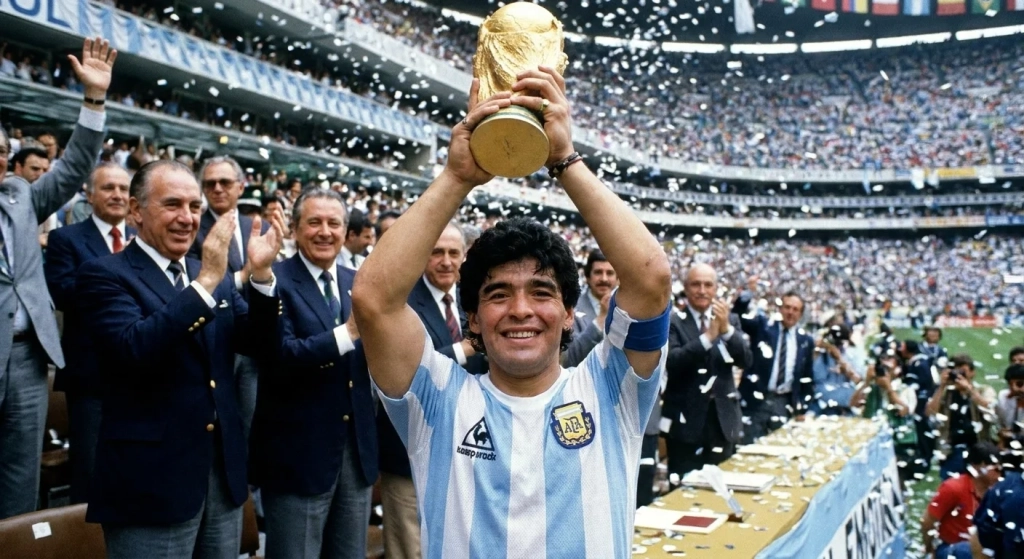
Some players define an era. Others simply invent a new way of seeing the game. Diego Armando Maradona belongs to that second group. He was born on October 30, 1960, in Villa Fiorito, in Buenos Aires province, and from a very young age he was doing things on the field that nobody else could do. His brother Lalo once summed it up in a way that stuck forever: he wasn't a soccer player, he was an alien.
His debut came impossibly early: he was just 15 years old when he stepped onto a First Division field wearing the Argentinos Juniors jersey, on October 20, 1976, in a 1-0 loss to Talleres de Cordoba. Juan Carlos Montes, that team's coach, had given him a line that sounded almost like a prophecy:
Go on, kid. Play the way you know how, and if you get the chance, nutmeg somebody.Juan Carlos Montes
Diego did that and a whole lot more. He stayed at the club known as El Bicho de La Paternal until 1980 and left an enormous mark: 166 games and 111 goals. They loved him so much there that the club's stadium is named after him to this day.
From Boca to Europe, with Naples as his Greatest Love
Next came the club he'd grown up rooting for: Boca Juniors. He debuted on February 22, 1981, against Talleres de Cordoba, a 4-2 win in which he scored twice. That year he won the Metropolitano title. In total, during that first stint with the Xeneize, he played 40 games and scored 28 goals. His jump to Europe took him to Barcelona, where he debuted on September 4, 1982, against Valencia. With the Catalan club he won the Copa del Rey and the Copa de la Liga, and he departed on May 5, 1984, with a loss in the Copa del Rey final against Athletic Bilbao. He left behind 58 games and 38 goals.
But the place where Diego was truly happy was Naples. He debuted on September 16, 1984, in a 3-1 loss to Verona, and went on to become an absolute legend in the city: even today it's impossible to walk through Naples without running into a mural or some tribute to him. With Napoli he won the club's first ever Scudetto in the 1986/87 season, repeated the feat in 1989/90, and also added the 1986/87 Coppa Italia, the 1990 Italian Supercup, and the 1988/89 UEFA Cup. He left on March 24, 1991, after a loss to Sampdoria, with 259 games and 115 goals to his name.
He had a stint at Sevilla, where he debuted on October 4, 1992, in a 2-1 loss to Athletic Bilbao (29 games, 8 goals), and a very brief spell at Newell's Old Boys in 1993: just five games, no goals, at the club where Lionel Messi would come up years later. His career came full circle back at Boca: he returned on October 7, 1995, and hung up his boots on October 25, 1997, in a 2-1 game against River Plate. In that second stint he played 30 games and scored 7 goals. In total, across 21 years of his career, 679 games and 345 goals.
The 1986 World Cup, the Hand of God, and the Shadows of Doping
With the Argentina national team he debuted at just 16 years old, on February 27, 1977, against Hungary, at La Bombonera, in a 5-2 rout. Then came what made him eternal: world champion at the 1986 World Cup in Mexico, a tournament where he scored what many consider the greatest goal in the history of the sport against England. He was also runner-up at Italy 1990, with the second Hand of God thrown into the mix. It wasn't all glory. On March 17, 1991, following a Napoli match, he tested positive for cocaine and was suspended for 15 months. And at the 1994 World Cup in the United States, after Argentina beat Nigeria 2-1, he tested positive for ephedrine. Devastated, he said FIFA had "cut off his legs."
Maradona the Coach
He could never stay away from soccer. He made his coaching debut at Deportivo Mandiyu in 1994 (12 games, 1 win, 6 draws, 5 losses), and the following year he managed Racing Club (11 games, 2 wins, 6 draws, 3 losses). His greatest dream came true between 2008 and 2010: managing the Argentina national team, including at the World Cup in South Africa, with 24 games, 18 wins and 6 losses. Afterward he had stints at Al Wasl and Al Fujairah in the United Arab Emirates, at Dorados de Sinaloa in Mexico (38 games, 20 wins, 9 draws, 9 losses), and, in his final chapter, at Gimnasia y Esgrima de La Plata (20 games, 7 wins, 5 draws, 8 losses). His overall winning percentage as a coach closed out at 55.16 percent.
Between the titles, individual honors, and recognitions that followed him for decades, the Golden Ball of the 1986 World Cup, the Bronze Ball at Italy 1990, being named among the FIFA 100 in 2004, and having his name on the Argentinos Juniors stadium, Maradona's career ended up being far more than a collection of statistics. He was, as any Argentine fan would simply put it, God.