 NAL
NAL CAR
CAR COL
COL AUD
AUD CNA
CNA SPA
SPA HFD
HFD LOU
LOU LDN
LDN ATL
ATL MTY
MTY CTJ
CTJ ATS
ATS BRB
BRB LCA
LCA SKN
SKN JAM
JAM GUA
GUA HON
HON SUR
SUR SLV
SLV MTQ
MTQ CAV
CAV SUP
SUP UMA
UMA ISF
ISF UAT
UAT KHA
KHA ELP
ELP TUL
TUL GEO
GEO NIR
NIR ARM
ARM LVA
LVA HUN
HUN UKR
UKR ITA
ITA BEL
BEL MNE
MNE CYP
CYP POL
POL BIH
BIH SWE
SWE ROU
ROU TUR
TUR FRA
FRA AUS
AUS BRA
BRA IND
IND PAN
PAN BER
BER GLP
GLP GRN
GRN CUB
CUB MOZ
MOZ SEN
SEN SDN
SDN ETH
ETH TAN
TAN GNB
GNB NIG
NIG LES
LES NGA
NGA MAD
MAD RWA
RWA LBR
LBR TOG
TOG BDI
BDI MWI
MWI SSD
SSD GAM
GAM SOM
SOM ALG
ALG ZAM
ZAM MAR
MAR GAB
GABSouth America at the 2030 World Cup: three symbolic matches and a disappointed region
Argentina, Uruguay and Paraguay will host only the opening stage while the real tournament plays out in Europe and Africa.

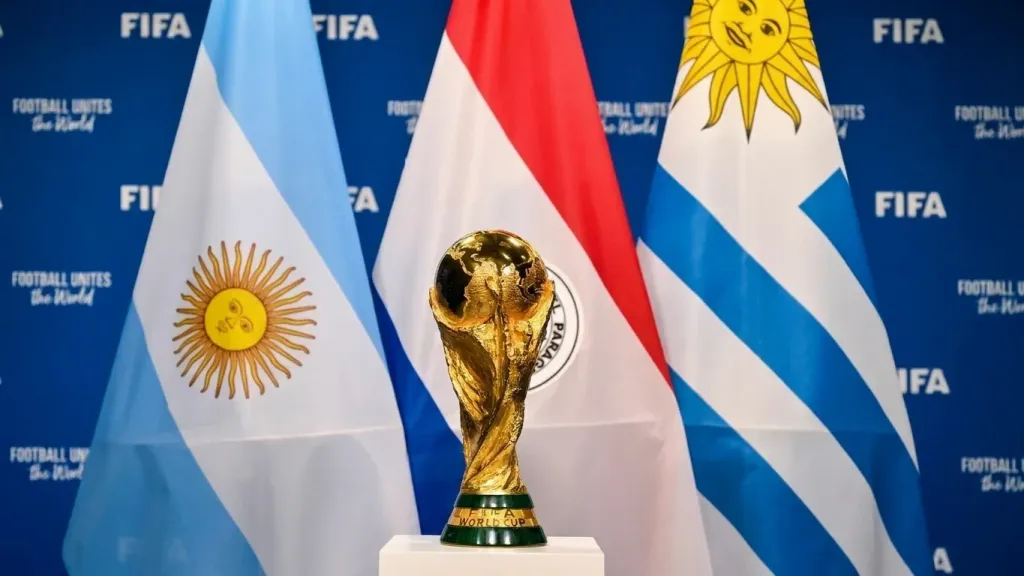
Three matches. That's all South America got in the carving up of the 2030 World Cup. One for Argentina, one for Uruguay, one for Paraguay. Everything else, dozens of games, will be played in Spain, Portugal and Morocco. And in that lopsided split lies the reason the region greeted the news with more resignation than celebration.
It sounds odd, because on paper there's plenty to celebrate. The tournament returns to Argentina 52 years after 1978, a country that spent all that time watching the United States and Mexico host the World Cup twice each. Paraguay, which in 110 years of Copa America history has hosted the tournament just once, will have a World Cup match on its soil for the first time ever. And Uruguay will reclaim the spotlight it held at the very beginning: the Estadio Centenario in Montevideo, built in 1930 to mark the centennial of Uruguay's constitution, will host the opening match, closing a hundred year circle almost to the day.
But do the math and the excitement cools fast. South America hasn't hosted a World Cup nearby since Brazil 2014, and now that it's finally arrived, it amounts to little more than a symbolic postcard: three matches split among three countries, while the real tournament, with its round of 16, quarterfinals, semifinals and final, plays out on the other side of the Atlantic. It's a gesture, sure, toward the region that gave birth to the competition. But a thin one. And on top of that, it's a move that also rearranges the political chessboard: by handing those three matches to South America, FIFA spreads hosting duties across Europe, Africa and South America, clearing an easier path for the 2034 World Cup to be held in Saudi Arabia.
The fight over 64 teams
Inside CONMEBOL, the debate that actually matters right now isn't how many matches South America landed in 2030, but whether the tournament will expand to 64 national teams. At first glance it seems like an idea with little upside for the region: the current 48 team format already gives South America a long, competitive and profitable qualifying process, with six direct qualifiers among its ten countries and a seventh fighting for the playoff spot. Expanding the World Cup would devalue exactly that, a qualifying process that generates significant revenue for several federations.
Looking ahead to 2030, though, the calculation shifts. A bigger tournament would almost certainly mean more matches for South America, something that would justify investments already underway, like the new stadium Paraguay plans to build. That need largely explains why CONMEBOL stayed quiet during the recent controversy surrounding Gianni Infantino and his questionable private investment plan. It didn't step up to back him enthusiastically, since it didn't feel FIFA had given it what it wanted for 2030 either. But it didn't want to pour fuel on the fire either.
The reason is simple: South America has only 10 votes and needs allies. Relations with UEFA have improved in recent years, but the wariness of European dominance remains intact. It's worth remembering that it was Brazil's João Havelange who broke that grip back in 1974 by teaming up with Africa and part of Asia, a precedent that still carries weight in the confederation's memory.
And even if South America ends up landing more matches in an eventual 64 team World Cup, the sense of a clumsy gesture is unlikely to fade. There's also the weather to consider: June and July in Argentina, Uruguay and Paraguay fall in the depths of the southern winter, with cold wind blowing in almost straight from Antarctica, while Spain, Portugal and Morocco will be enjoying a summer of strong sun. If South American fans are already viewing this World Cup with more caution than excitement, the players have concrete reasons to worry about competing across such a stark temperature gap on opposite sides of the Atlantic.