 IND
IND GUV
GUV ANT
ANT UCH
UCH COQ
COQ COB
COB INT
INT COR
COR REM
REM GRE
GRE RBB
RBB MIR
MIR VIT
VIT CHA
CHA BOT
BOT VAS
VAS CRU
CRU SAO
SAO USM
USM CRB
CRB BIS
BIS MCA
MCA JSS
JSS CSC
CSC JSK
JSK MCO
MCO ENS
ENS ASO
ASO OP
OP FCU
FCU GUA
GUA THS
THS FOR
FOR PAC
PAC LAC
LAC ITO
ITO SUP
SUP SHJ
SHJ GGP
GGP NJC
NJC SXU
SXU FNA
FNA GXH
GXH TAT
TAT GRI
GRI JXL
JXL DLK
DLK NHC
NHC XMF
XMF DYN
DYNAlberto Spencer and the 54 Libertadores Goals Nobody Has Matched in Over Fifty Years
The Ecuadorian arrived in Uruguay almost unknown and ended up becoming, with 54 goals, the all-time leading scorer in the history of the tournament.

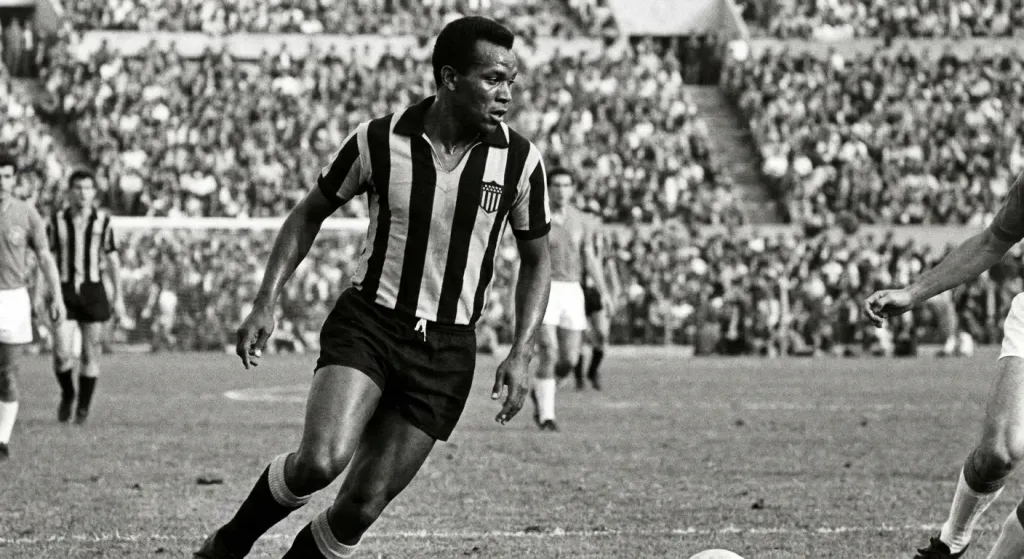
Some numbers speak for themselves, and 54 goals in the Copa Libertadores is one of them. That number belongs to Alberto Spencer, an Ecuadorian who arrived in Uruguay as a virtual unknown and ended up becoming the scoring benchmark for an entire continent. More than half a century later, nobody has managed to top him. And once you go through how he scored those goals, it's easy to understand why the Uruguayan press gave him a nickname that defines him better than any statistic: "the man of the important goals."
Spencer was born in Ancón, in Ecuador's Santa Elena province, on December 6, 1937. He arrived at Peñarol at just 22 years old, after scoring more than a hundred goals for Everest and standing out with Ecuador's national team at the 1959 Extraordinary South American Championship. Nobody could have imagined back then that this move would turn him into the scoring symbol of the Copa de Campeones de América, the name under which the tournament we now know as the Libertadores began.
His debut couldn't have been more emphatic. On April 19, 1960, in the Cup's opening match between Peñarol and Jorge Wilstermann, Spencer scored four goals in Peñarol's 7-1 win. That first edition ended up being his: he finished as top scorer with seven goals, including the two that eliminated a San Lorenzo side led by star forward José Sanfilippo, and the lone goal in the final against Olimpia, played at the Estadio Centenario. Peñarol was crowned champion, and Spencer was already building his legend.
The following year he repeated the formula: once again his goal tipped the first leg of the final against Palmeiras, and Peñarol went back to back. In 1962, even though the team fell short of a third straight title, the Ecuadorian delivered one of his most memorable performances. Peñarol and Nacional met in the Cup's first ever matchup between two clubs from the same country, and Spencer came up with decisive goals in the rematch and again in the playoff, carrying Peñarol through to the final against Pelé's Santos.
That final was lost, but it left behind another memorable chapter: in the second match, played in Brazil, Peñarol pulled off a historic 3-2 win with two goals from Spencer, after having fallen in Montevideo.
The leap nobody has matched
In 1963 came another personal milestone: Spencer became the first player to score five goals in a single match in the Cup, with Everest, his former club, on the receiving end. His game was built on uncommon physical power, a leap that let him dominate the air, and a sharp, first-time finish on the run.
In 1966 he was decisive once again for a new Peñarol title: of the six goals he scored that year, three came right in the finals against River Plate, including both goals in the playoff match that sealed the title for the black and yellow. Between 1967 and 1970 he didn't lift the Cup again, but his goals kept showing up at the moments that mattered: a late winner gave Peñarol a classic victory in 1968, and in 1970 he contributed two goals in an 11-2 rout of Venezuela's Valencia, still the largest margin in the tournament's history.
In 1971 he moved to Barcelona of Guayaquil, the very club he had scored against in 1969, and there he added the final six goals of his personal tally, reaching those 54 goals in eleven editions (of the first thirteen Cups, he only failed to score in 1964 and 1965).
Behind him on the tournament's all-time scoring list are some huge names, which gives an idea of just how far ahead he pulled: Uruguay's Fernando Morena with 37 goals, Pedro Virgilio also with 37, Argentina's Daniel Onega with 31, Brazil's Gabriel Barbosa with 31, and Julio César "Cascarilla" Morales with 30. All of them far behind those 54 goals that Spencer scored against goalkeepers from twenty-six different clubs, spread across all ten CONMEBOL countries.
Alberto Spencer passed away in November 2006, but his record still stands as the highest peak in Copa Libertadores scoring history, the tournament he helped define from his very first match with four goals, and one he never stopped treating as his own.