 IND
IND GUV
GUV ANT
ANT UCH
UCH COQ
COQ COB
COB INT
INT COR
COR REM
REM GRE
GRE RBB
RBB MIR
MIR VIT
VIT CHA
CHA BOT
BOT VAS
VAS CRU
CRU SAO
SAO USM
USM CRB
CRB BIS
BIS MCA
MCA JSS
JSS CSC
CSC JSK
JSK MCO
MCO ENS
ENS ASO
ASO OP
OP FCU
FCU GUA
GUA THS
THS FOR
FOR PAC
PAC LAC
LAC ITO
ITO SUP
SUP SHJ
SHJ GGP
GGP NJC
NJC SXU
SXU FNA
FNA GXH
GXH TAT
TAT GRI
GRI JXL
JXL DLK
DLK NHC
NHC XMF
XMF DYN
DYNTito Gonçalves, the "Captain of Captains" Who Made Peñarol His Entire Life
He turned down Real Madrid and River Plate to never leave the club where he remains the all-time appearance leader, and where he even discovered a young Valverde.

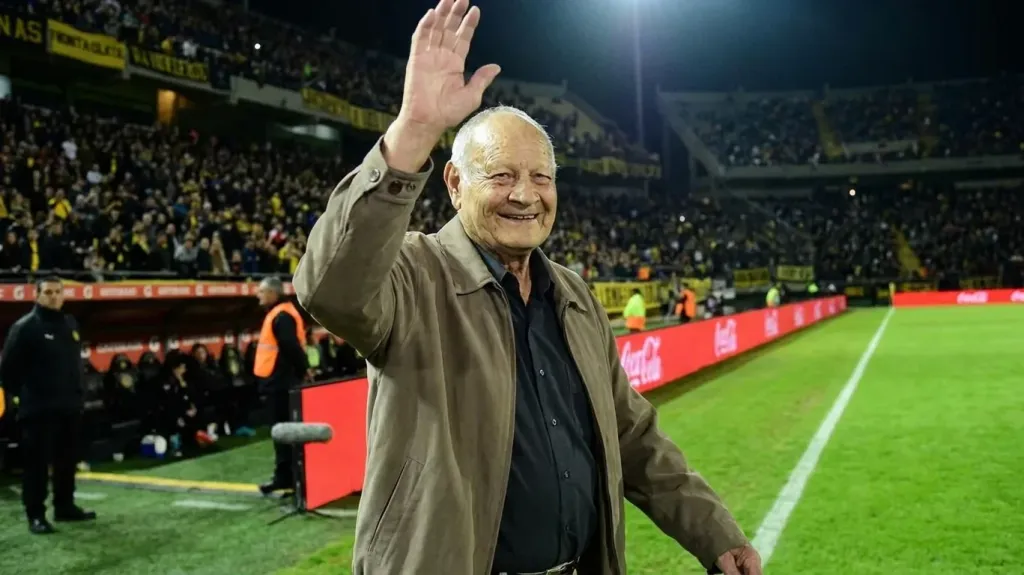
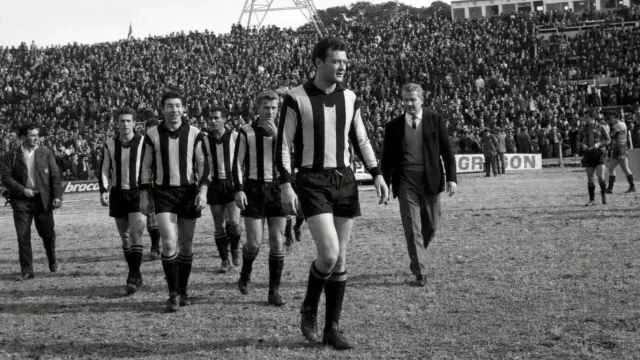
Some nicknames are earned in a single match. Others are built over an entire lifetime. Néstor "Tito" Gonçalves belongs to that second category: they called him the Captain of Captains, and it was no exaggeration from some overeager writer. It was simply the summary of an entire career spent in Peñarol's black and gold.
Gonçalves was born on April 27, 1936, in Isla Cabellos, a spot in Artigas that in 1956 was renamed Baltasar Brum. He arrived in Montevideo that same year for a trial with Peñarol, coming from Universitario de Salto, and he did it under a changed last name. That was no small administrative footnote either: it ended up causing a rupture in relations between the Organización del Fútbol del Interior (OFI) and the Uruguayan Football Association (AUF). That is how eventful things got right from the start.
Oddly enough, when he made his debut for the Uruguayan national team on March 23, 1957, against Peru at the South American Championship in Lima, he had not even officially played for Peñarol yet, even though he had already requested his transfer. He would go on to win 50 caps through 1971 with the Celeste, appearing in two World Cups: England 1966 and Mexico 1970.
At club level, his story was one of a loyalty rarely seen in that era. He had offers from River Plate and, no less, Real Madrid, and he never budged. His entire career unfolded between the sky blue of the national team and the black and gold of Peñarol, the club where he remains, to this day, the player with the most appearances in its history.
Journalist Franklin Morales described him in late November 1965 in the newspaper Hechos as an "absolute winner in the traditional battles," someone who imposed a style of play that, as he wrote, remained intact through sheer presence and gravitational pull. Little more needed to be said about what it meant to have him as your center half.
A Trophy Case That Commands Respect
The numbers back up every bit of praise. Gonçalves won nine Uruguayan championships (1958, 1959, 1960, 1961, 1962, 1964, 1965, 1967 and 1968), was part of the club's first great five-year run of dominance, and added three Copa Libertadores titles (1960, 1961 and 1966), two Intercontinental Cups (1961 and 1966) and an Intercontinental Champions' Supercup in 1969.
He was captain for the 1966 Intercontinental Cup against Real Madrid, with wins both in Montevideo and in Madrid itself, results that still support something curious to this day: Uruguayan soccer is the only national game in the world with a winning record against Real Madrid. That kind of leadership put him, in the eyes of many, on the same level as Nasazzi and Obdulio Varela among the great commanding figures of 20th century Uruguayan soccer.
Peñarol means life to me. Being Peñarol's captain was a tremendous responsibility.Néstor "Tito" Gonçalves
The Eye That Discovered Valverde
His bond with the club did not end when he hung up his boots. He worked as the groundskeeper at Las Acacias, and from that post he had the chance to watch kids who would later shine in the first division. One of them was Federico Valverde. According to a 2022 FIFA report, after watching the youngster play, Tito turned to his son Néstor, who was in charge of scouting, and said: "Did you see what that skinny kid can do?"
I was just a kid, I didn't have much of a sense of who Peñarol's idols were, and when my father found out, he said to me, "How could you not say hello to him!" At the time, I didn't appreciate it the way I do today.Federico Valverde
In March 2016, he was on hand for the inauguration of Estadio Campeón del Siglo, one of the last major public appearances of his life tied to the club. That same December, he was hospitalized for a liver complication that led to a cardiac problem, and on December 29, 2016, he died in Montevideo. Today, Peñarol's Ciudad Deportiva training complex bears his name, a fitting tribute to a man who made the black and gold jersey the meaning of his entire life.